Six Degrees: find connections between artists
I used Kapell's data graph to build a fun tool for finding connections between any two artists.

Learning about music is dope because I find all kinds of connections I didn’t know existed. Yesterday it was a peculiar connection between New York, Memphis, and New Orleans by way of one song. Add that to the regular “woah!” moments I have reading Kapell’s liner notes behind songs and I’m constantly picking up neat new connections. That got me thinking… could I make something to track those down?
Meet Six Degrees
It’s not as many degrees as Juvenile’s 400 Degreez (on Kapell) but six degrees of separation or less are usually suitable to bring two people together. How true is that for music?
Six Degrees is a little toy I made that uses Kapell’s graph to find connections. Pick two artists and it finds the shortest route between them. Each node cites a record and what each person did on it. You can use it. Do it!
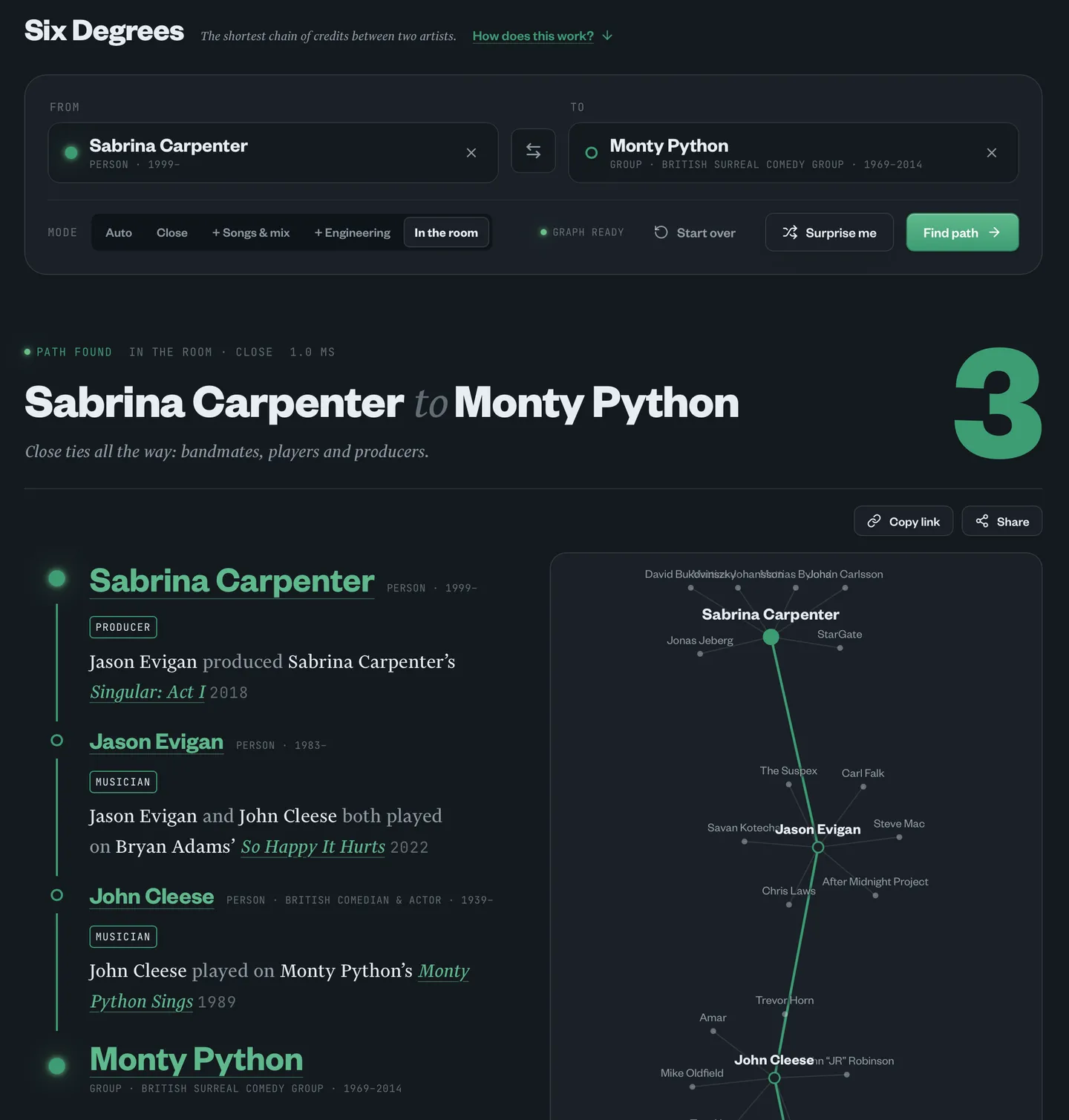
There are a couple different modes you can try to mix things up. I found some “interesting” connections:
- Sabrina Carpenter to Monty Python through John Cleese (!), via a Bryan Adams record.
- Katy Perry to The Temptations through James Brown.
- Desiigner to Kenny G by way of keyboardist Greg Phillinganes.
- Cardi B to Fleetwood Mac due to a connection with Prince.
How It Works
Six Degrees is powered by the MusicBrainz part of Kapell’s big ol’ graph describing who was in what band and who’s credited on which records: producers, writers, players, mixers, engineers, and the mastering blah blah long list. Six Degrees looks for the shortest path through that graph for the artists you pick.
(Un)fortunately(?), some people are credited on everything. A busy mastering engineer can connect almost any two artists in two hops, which is true but… boring. So the default, Auto, tries close ties first: bandmates, players and producers. If that fails it adds songwriters and mixers, and engineers and sleeve credits come last. You can also pick an approach yourself if you want to see different answers.
Another wrinkle: writing credits include the writers of anything sampled. So a chain can run through someone who never set foot in the studio, because their record got flipped decades later. The “In the room” mode tries to fix that writing-credit-connection thing by not using writing credits.
The whole graph downloads to your browser once. After that, every search runs on your device and comes back instantly.
That’s It!
I thought this was a pretty dope way to flex Kapell’s data, add discovery interest, and to make something I can use to promote Kapell as a music player. I hope you’ll check it out. If following credits is your thing, that’s what Kapell does in the app. It’s on the Mac App Store.